
A Brief Guide to CES Marketing Compliance
 Kaamel Lab

CES marketing takes many forms, including booth displays, product demonstrations, website promotions, media interviews, and conversations at the event. Statements about privacy protections, product performance, and certifications influence how audiences understand and select products, and may also be examined in consumer protection enforcement. A key question is whether the claims match the product’s actual functions, data processing activities, and supporting evidence.
Drawing on US consumer protection rules and illustrative cases, this article outlines the legal basis, scope of review, and common risks associated with CES marketing, focusing on privacy promises, performance claims, certification statements, and endorsements.
Legal basis for exhibitor marketing
A company’s statements about a product’s privacy protections, whether at its booth, on its website, or in promotional materials, can influence consumers’ decisions to buy the product, use the service, or provide personal information. US consumer protection rules impose basic requirements: statements must not be false or misleading, objective claims must have a reasonable basis, and material information affecting consumers’ understanding must be adequately disclosed. The principal sources include Section 5 of the FTC Act, FTC policy statements and guidance, and applicable state advertising and consumer protection laws.
(1) Federal consumer protection rules
1. Truthfulness of marketing claims
Section 5(a)(1) of the Federal Trade Commission Act (FTC Act), 15 U.S.C. §45(a)(1), prohibits unfair or deceptive conduct in or affecting commerce: “unfair or deceptive acts or practices in or affecting commerce, are hereby declared unlawful.” In other words, such acts or practices are unlawful when they occur in or affect commerce.
The FTC’s Policy Statement on Deception explains three elements of deception: whether there is a representation, omission, or practice likely to mislead consumers; whether consumers’ interpretation is reasonable in the circumstances; and whether the information is material, meaning that it is likely to affect consumers’ decisions or conduct regarding a product or service. Whether privacy marketing is misleading therefore depends on consumers’ reasonable understanding of the communication as a whole, including both its express statements and implied meanings.
2. Substantiation of marketing claims
For objective claims, the FTC’s Policy Statement Regarding Advertising Substantiation requires that “advertisers and ad agencies have a reasonable basis for advertising claims before they are disseminated.” Advertisers and agencies must therefore possess a reasonable basis for their claims before communicating them. The evidence required depends on factors including the claim, the nature of the product, and the consequences of a false claim. Publishing first and obtaining evidence later does not satisfy this timing requirement.
3. Disclosure of necessary information
Where a claim requires an explanation of conditions or limitations, Section III.A, “The Context of the Disclosure,” of the FTC’s .com Disclosures guidance requires necessary disclosures to be clear and conspicuous: “A disclosure can only qualify or limit a claim to avoid a misleading impression. It cannot cure a false claim.” Disclosures may qualify a claim to avoid misleading consumers, but cannot correct a false claim. If supplementary information contradicts the main claim, the claim itself needs to change.
These policy statements and guidance explain how the FTC applies Section 5 and provide the basis for assessing truthfulness, substantiation, and the adequacy of disclosures.
4. Endorsement requirements
Companies using influencer experiences, expert recommendations, or consumer reviews to promote products also need to consider the Guides Concerning Use of Endorsements and Testimonials in Advertising, 16 CFR Part 255. The Guides explain the application of Section 5 of the FTC Act to endorsements and testimonials.
Section 255.1 requires endorsements to reflect the endorser’s honest opinions, findings, beliefs, or experience. They must not convey claims that would be deceptive if made directly by the advertiser. Advertisers may remain liable for misleading or unsubstantiated claims communicated through endorsements.
Section 255.5 further requires clear and conspicuous disclosure of a connection between an endorser and a seller if it might materially affect the weight or credibility of the endorsement and is not reasonably expected by the audience. Payments and free products are among the arrangements that may need to be assessed.
5. Responsibility for privacy promises
In BetterHelp, the FTC’s administrative complaint alleged that the company expressly or implicitly represented that it would not disclose consumers’ health information to third parties for advertising or those third parties’ own purposes, while in fact providing such information to Facebook and other parties for those purposes.
In paragraphs 89–91 of its final administrative complaint, the FTC alleged that these representations were false or misleading and constituted “deceptive acts or practices in violation of Section 5 of the FTC Act.”
The matter was resolved through a consent order. The final order, approved in July 2023, required BetterHelp to pay $7.8 million to provide partial refunds to consumers and imposed requirements concerning health data sharing, data deletion, and privacy management. The company generally neither admitted nor denied the complaint’s allegations.
The case directly illustrates that statements about the use and disclosure of personal information can be subject to enforcement under Section 5 of the FTC Act. Privacy promises in exhibitor marketing likewise call for a review of their content, supporting evidence, and necessary disclosures under these rules.
(2) State consumer protection rules
Marketing may also be subject to state law. In Nevada, where CES is held, NRS 598.0915(5) classifies knowingly making false representations about the characteristics, uses, benefits, or other attributes of goods or services as a deceptive trade practice. NRS 598.0923(1)(b) also addresses knowingly failing, in the course of business, to disclose a material fact connected with the sale or lease of goods or services.
Where marketing has the relevant connections to California, its False Advertising Law (FAL) and Unfair Competition Law (UCL) also require consideration. Business and Professions Code §17500 prohibits, under the conditions set out in that provision, disseminating advertising statements known to be untrue or misleading, or that should be known to be so through reasonable care. Section 17200 covers unlawful, unfair, or fraudulent business acts or practices, as well as unfair, deceptive, untrue, or misleading advertising.
Which state laws apply depends on the connections between the dissemination of the marketing, the transactions, the relevant parties, and each state. The event’s location alone does not determine all applicable rules.
Scope of marketing review
During CES, companies introduce products through booths, websites, social media, and media coverage, as well as presentations and customer questions at the event. All of these communications can influence audiences’ understanding of a product’s privacy protections.
Section II of the FTC’s Policy Statement on Deception addresses written and oral misrepresentations and material omissions, assessing deception in the context of the entire advertisement, transaction, or course of dealing. Reviewing privacy marketing therefore involves product statements across channels and the meaning conveyed jointly by words, visuals, and demonstrations.
(1) Marketing at the exhibition
Booth backdrops, posters, brochures, product packaging, and information cards directly convey the product information a company wishes to communicate to attendees. Promotional videos, presentation slides, and live demonstrations serve the same purpose. Their text, images, sound, and operating sequences need to be considered together.
Section II.A of the FTC’s Health Products Compliance Guidance lists forms of advertising that include packaging, labeling, brochures, and promotion at trade shows, conferences, and seminars. It explains that promotional information for health-related products communicated through these channels must comply with the same truth-in-advertising principles.
For live demonstrations, relevant questions also include whether the operations match the explanation and whether the demonstration fully presents the conditions needed to understand the product. Audiences may form their impressions from both the promotional wording and the demonstration they observe.
(2) The company’s online marketing
Websites, product landing pages, and posts, videos, and livestreams on official social accounts extend exhibition marketing online. Specific explanations given through official accounts when introducing products or answering functional questions may also affect consumer decisions.
The same exhibition material can convey different information when published on different platforms. For example, a live demonstration may include a full explanation of a function, while an edited short video retains only the result. Conditions originally displayed alongside a claim may be cropped out when an image is reposted. Under the guidance on clear and conspicuous disclosures in Section III of .com Disclosures, review needs to consider what is actually published on each channel, including whether titles, accompanying text, subtitles, and visuals retain the necessary information.
(3) Media promotion
Press releases, media kits, and product statements made by company representatives in interviews belong within the scope of marketing review. Where a company commissions promotional content from media outlets or influencers, the product statements also need review, together with an assessment of whether the relationship calls for endorsement disclosures.
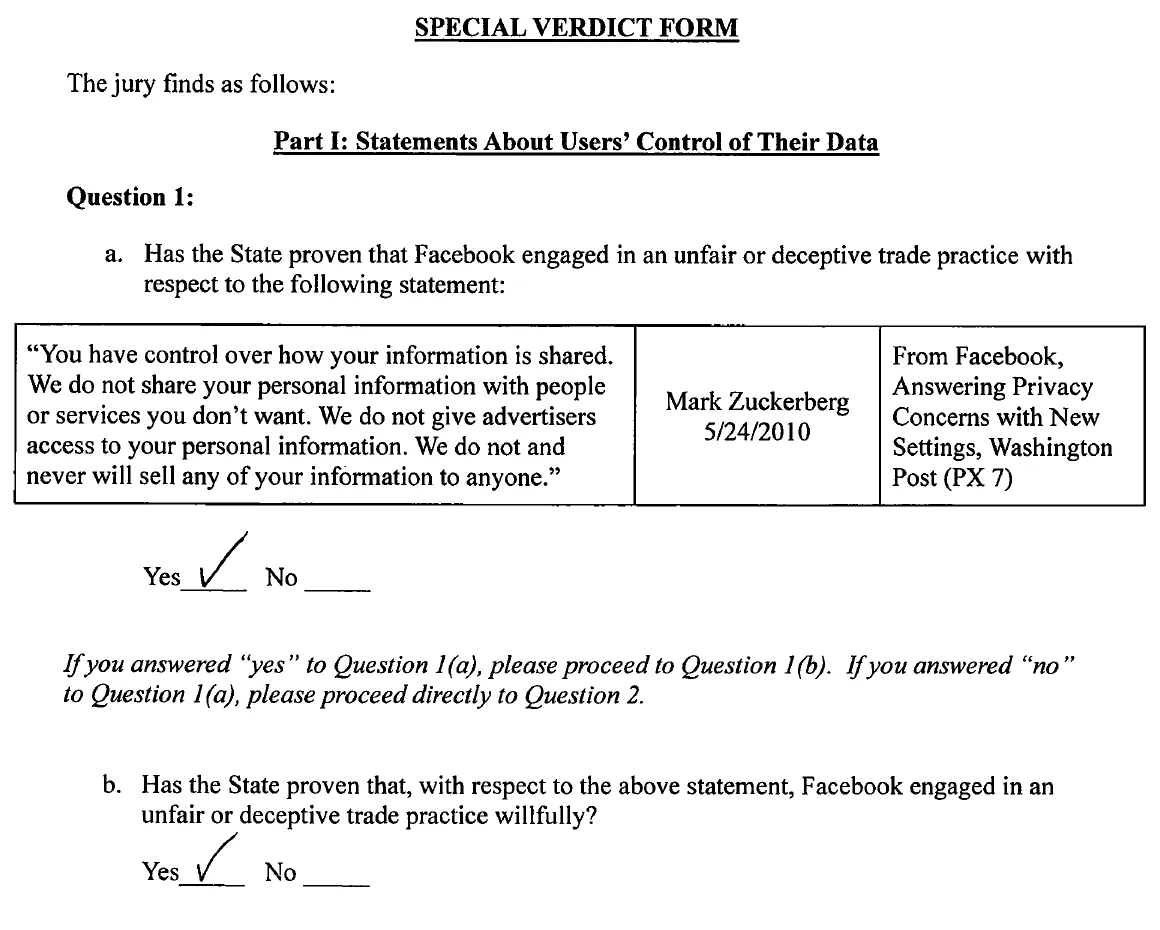
In New Mexico v. Facebook, Question 1 of the jury verdict form reproduced statements made by Mark Zuckerberg in a Washington Post article dated May 24, 2010. The statements addressed users’ control over information sharing, advertisers’ access to personal information, and whether Facebook sold user information. The jury found that Facebook engaged in an unfair or deceptive trade practice with respect to the statement, and that it did so willfully. Privacy statements made by company leaders in media articles can thus be examined in consumer protection proceedings.
A company’s use of media coverage and consumer reviews can also create new advertising content. Section 255.0(g)(1) of the Endorsement Guides explains that an excerpt from an independent film review becomes an endorsement when used in the producer’s advertisement; a distorted excerpt may make the advertisement deceptive. Section 255.0(g)(7)(i) also explains that prominently featuring a consumer review on the manufacturer’s homepage can turn it into an endorsement in advertising.
This part of the review therefore addresses both what the company supplies to the media and how it selects, edits, and uses third-party coverage or reviews.
(4) Oral product statements
Company leaders introducing products in interviews, launches, and public meetings, and sales staff explaining functions at booths or in customer discussions, can all make statements that affect their audiences’ judgments. Section II of the FTC’s Policy Statement on Deception expressly addresses oral misrepresentations and material omissions.
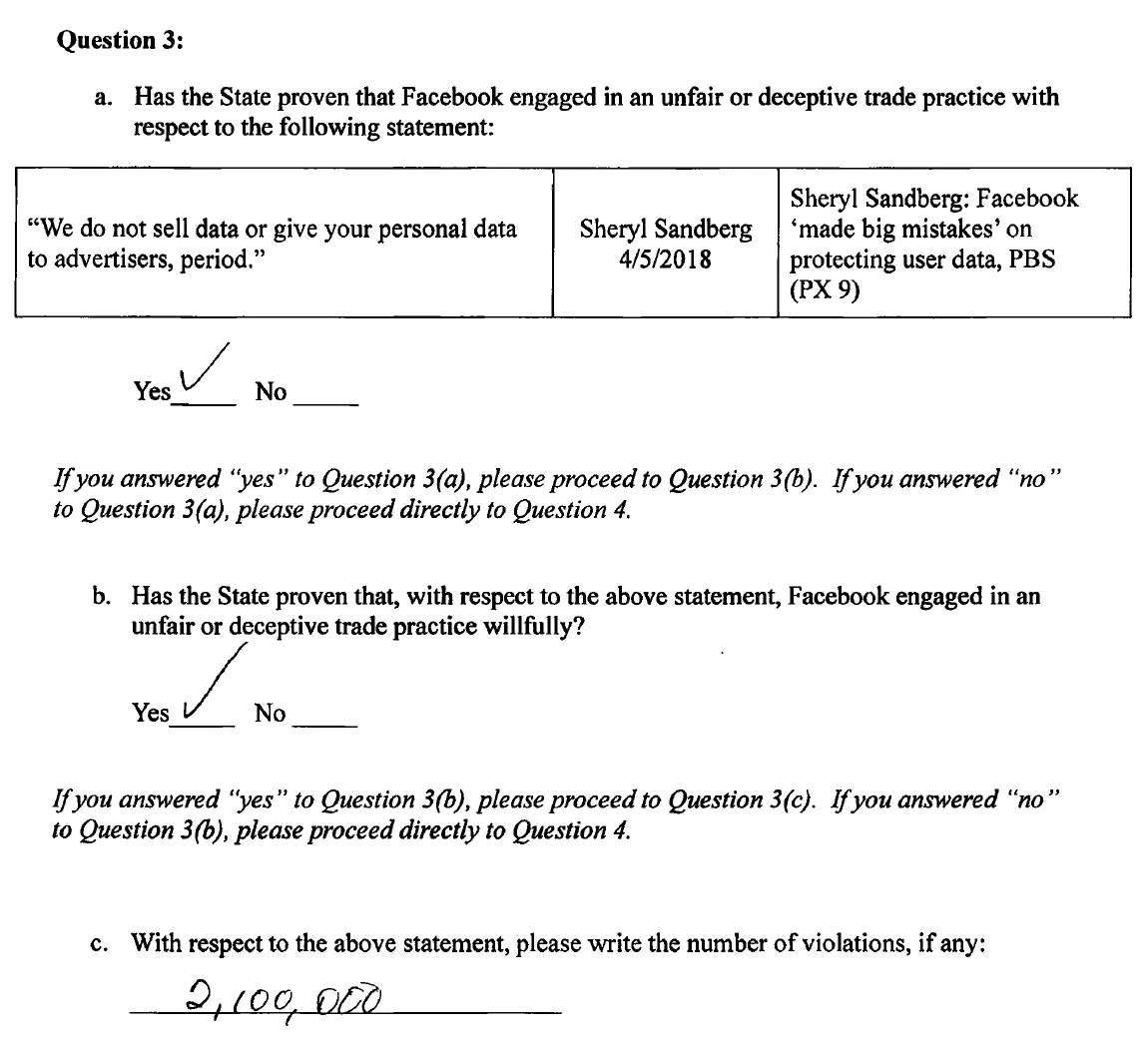
Question 3 of the jury verdict form in New Mexico v. Facebook reproduced a statement made by then-Facebook Chief Operating Officer Sheryl Sandberg in an interview with PBS on April 5, 2018: “We do not sell data or give your personal data to advertisers, period.”
The jury found that Facebook engaged in an unfair or deceptive trade practice with respect to this statement, and that it did so willfully. Oral explanations in interviews, like written marketing statements, can provide a basis for consumer protection liability.
For CES exhibitors, the review can accordingly cover interview outlines for company leaders, product presentation scripts, demonstration scripts, and sales Q&As, checking statements against the product’s actual characteristics. Unscripted explanations by staff also need to be assessed in light of their content, the speaker’s role, and the context of the exchange.
Common risks in product marketing
Consumer protection risks often arise from a gap between the expectations created by marketing and the actual circumstances: privacy promises may fail to reflect the full data processing activities, performance claims may exceed the available evidence, certifications or test results may be used beyond their scope, and third-party endorsements may depart from genuine experience. The following issues are particularly relevant to CES product displays and promotion.
(1) Privacy promises inconsistent with actual data processing
Statements such as “data is processed only locally,” “we do not share personal information with third parties,” and “users have complete control over their data” describe how a company handles data. Under the FTC’s Policy Statement on Deception, a representation or omission may be deceptive if it is likely to mislead consumers acting reasonably in the circumstances and affect their purchasing or usage decisions. Privacy marketing risks therefore include both false promises and omissions of material facts about data processing.
In Avast, the FTC alleged that the company promoted its software as protecting privacy and blocking third-party tracking, while collecting detailed browsing data through browser extensions and antivirus software and selling it to third parties through its subsidiary Jumpshot, without adequately informing consumers. The final settlement order, approved in 2024, required Avast to pay $16.5 million and prohibited it from selling or licensing the relevant browsing data for advertising purposes.
For products exhibited at CES, a similar problem can arise when a technical function is presented as a broader privacy promise. For example, a device may perform speech recognition locally but separately upload audio clips for quality analysis. Describing the first function as “all voice data stays on the device” omits a processing activity capable of changing consumers’ understanding.
Supplementary information in a privacy policy may not eliminate a misleading main claim. Section III.A of .com Disclosures explains that a disclosure can qualify or limit a claim but cannot cure a false claim. A homepage promise that “data never leaves the device” and a privacy policy stating that data may be uploaded are substantively contradictory, rather than further explanations of the same promise.
(2) Insufficient evidence for product performance claims
Product marketing often uses measures of accuracy, recognition capabilities, health effects, or efficiency gains. The more specific the claim, the more definite consumers’ expectations of performance become. The FTC’s Policy Statement Regarding Advertising Substantiation requires a reasonable basis for express or implied objective claims before advertising is disseminated. If an advertisement states that a result has been established by testing or research, the advertiser must also possess evidence matching that representation.
For AI products, describing a technical capability as a substitute for professional services likewise requires supporting evidence. DoNotPay promoted its service as the “world’s first robot lawyer.” The FTC stated that the company had not tested whether its product could perform at the level of a human lawyer and had not retained attorneys to evaluate the quality and accuracy of its legal features. The final order, approved in 2025, required payment of $193,000 and restricted further claims of substituting for professional services without adequate substantiation.
In CES marketing, a gap between evidence and claims may also result from omitted testing conditions. For example, a speech recognition accuracy figure may come from tests using fixed commands in a quiet environment, while a promotional video depicts continuous natural conversation in a noisy setting. Even if the accuracy figure has a test record, the performance expectations conveyed by the video and wording together may exceed the test findings. Results obtained under specific conditions are being used to support performance across a wider range of use scenarios.
(3) Certification and test results used beyond their scope
Statements such as “certified,” “meets a particular standard,” and “tested by an independent laboratory” refer respectively to certification status, performance conformity, and the fact of testing. Consumers may rely on them to assess whether a product has undergone independent evaluation or achieved a particular quality or safety level. Nevada’s NRS 598.0915(2) classifies knowingly making false representations about the source, sponsorship, approval, or certification of goods or services as a deceptive trade practice.
Razer’s Zephyr mask case illustrates the risk of extending component test results to the performance of an entire product. The complaint stated that Razer marketed the product as offering “N95-grade” protection, although it lacked the relevant certification, and testing of the filter material did not substantiate the protection provided by the complete mask when worn. In 2025, the FTC distributed more than $1 million in refunds to consumers affected by the claims.
Similar differences in scope arise in smart-device marketing. Testing of a sensor, communications module, or other component may establish findings only for that component and under the conditions specified in the report. Presenting this as certification of the complete device expands both the subject of the evaluation and the nature of the conclusion. “Tested,” “meets a standard,” and “certified” express different facts. Using them interchangeably changes consumers’ understanding of the product’s credentials.
(4) Misleading endorsements or inadequate relationship disclosures
Consumers generally understand reviews, accounts of product experience, and expert recommendations as assessments based on a third party’s actual use or professional judgment. Section 255.1 of the FTC’s Endorsement Guides requires endorsements to reflect the endorser’s honest opinions, findings, or experience. Section 255.5 further requires clear and conspicuous disclosure of material connections that could affect credibility and that audiences would not ordinarily expect. Both the truthfulness of the recommendation and consumers’ awareness of the relationship between the endorser and company are therefore relevant to the review.
These requirements also apply where a company supplies a script to an endorser. In the Google and iHeartMedia matter, the FTC alleged that Google supplied radio personalities with Pixel 4 endorsement scripts based on personal experience, although most had not received the phone before recording the advertisements and could not endorse it from firsthand experience. The FTC approved final settlement orders against both companies in 2023.
Companies often re-edit on-site experiences, media interviews, and sponsored reviews from CES for use on websites or social media. Even a genuine original assessment can change meaning through editing: a brief trial of a demonstration version may be presented as an assessment of long-term use of the finished product, or approval of a particular function may be expanded into an endorsement of overall performance. Here, the risk of misrepresentation arises from the promotional adaptation of the original assessment, rather than the endorser’s initial statement.
Kaamel’s consumer marketing compliance review service
Kaamel provides consumer marketing compliance reviews for CES exhibitors, covering exhibition materials and promotional content on websites and landing pages published before the event.
The principal legal and regulatory sources for the review include:
- The FTC Act: provisions addressing false or misleading marketing;
- FTC policy statements and guidance: including the Policy Statement on Deception, Policy Statement Regarding Advertising Substantiation, .com Disclosures, the Endorsement Guides (16 CFR Part 255), and Health Products Compliance Guidance, addressing truthfulness, substantiation, necessary disclosures, and endorsements;
- State advertising, consumer protection, and privacy laws: identifying applicable provisions based on the connections between marketing and sales activities and each state, and reviewing the promotional content accordingly;
- Sector-specific laws such as COPPA and HIPAA: assessing whether promises concerning children’s privacy and health information protection meet applicable requirements, taking account of the product’s audience, data processing activities, and the company’s role in the business.
Using product documentation, information about data processing, test reports, and certification records, we assess the accuracy of privacy promises, performance descriptions, and certification statements, the adequacy of supporting materials, and any omissions of material limitations. Deliverables include:
- Marketing Compliance Risks and Remediation Recommendations: identifying specific statements that present risks, explaining the legal basis, and recommending revisions.
- Marketing Material Red Lines: specifying statements to avoid in future marketing and the evidence and disclosures required for particular claims.
References
Federal Trade Commission Act, 15 U.S.C. §45(a)(1), see: https://www.ftc.gov/legal-library/browse/statutes/federal-trade-commission-act; FTC Policy Statement on Deception, see: https://www.ftc.gov/system/files/documents/public_statements/410531/831014deceptionstmt.pdf; FTC Policy Statement Regarding Advertising Substantiation, see: https://www.ftc.gov/legal-library/browse/ftc-policy-statement-regarding-advertising-substantiation; FTC .com Disclosures, Section III.A, printed page 5, see: https://www.ftc.gov/system/files/documents/plain-language/bus41-dot-com-disclosures-information-about-online-advertising.pdf; Endorsement Guides, 16 CFR §§255.0, 255.1, 255.5, see: https://www.ecfr.gov/current/title-16/chapter-I/subchapter-B/part-255; BetterHelp final administrative complaint, paragraphs 89–91, see: https://www.ftc.gov/system/files/ftc_gov/pdf/2023169betterhelpcomplaintfinal.pdf; BetterHelp final decision and order, see: https://www.ftc.gov/system/files/ftc_gov/pdf/2023169betterhelpfinalorder.pdf; Nevada NRS Chapter 598, see: https://www.leg.state.nv.us/nrs/NRS-598.html; California Business and Professions Code §17500, see: https://law.justia.com/codes/california/code-bpc/division-7/part-3/chapter-1/article-1/section-17500/; California Supreme Court discussion of the FAL and UCL, see: https://supreme.courts.ca.gov/sites/default/files/supremecourt/default/2022-08/S250047.pdf; FTC Health Products Compliance Guidance, Section II.A, see: https://www.ftc.gov/business-guidance/resources/health-products-compliance-guidance; New Mexico v. Facebook jury verdict form, Questions 1 and 3, original pages 1 and 4, see: https://nmcourts.gov/wp-content/uploads/2026/09/Jury-Verdict-Form.pdf; Avast final complaint and consent order, see: https://www.ftc.gov/system/files/ftc_gov/pdf/202_3033_-_avast_final_consent_package.pdf; FTC explanation of the DoNotPay final order, see: https://www.ftc.gov/news-events/news/press-releases/2025/02/ftc-finalizes-order-donotpay-prohibits-deceptive-ai-lawyer-claims-imposes-monetary-relief-requires; Razer complaint, page 14, see: https://www.ftc.gov/system/files/ftc_gov/pdf/Razer-PACER-No1-Complaint.pdf; FTC announcement of Razer refunds, see: https://www.ftc.gov/news-events/news/press-releases/2025/01/ftc-sends-more-1-million-full-refunds-customers-deceived-false-claims-n95-grade-zephyr-face-masks; FTC announcement of final orders against Google and iHeartMedia, see: https://www.ftc.gov/news-events/news/press-releases/2023/02/ftc-approves-final-orders-against-google-iheartmedia-deceptive-air-endorsements-googles-pixel-4; FTC COPPA compliance FAQs, see: https://www.ftc.gov/business-guidance/resources/complying-coppa-frequently-asked-questions; HHS explanation of HIPAA covered entities and business associates, see: https://www.hhs.gov/hipaa/for-professionals/covered-entities/index.html
Related reading

EU Kids Act: Proposed Age-Based Restrictions on Minors’ Social Media Use
The EU Kids Act draft sets out age-based access rules, safer design, AI safeguards and audits. We examine the proposed changes and their implications for products.

Indonesia’s PDPL Implementing Regulation: Key GDPR Differences
How Indonesia’s PP 33/2026 and PDPL differ from the GDPR on contracts, individual rights, processing records, breach notices and international transfers.

ChatGPT Is Now a VLOSE Under the DSA: What Changes?
The European Commission has designated ChatGPT as a very large online search engine. We explain the DSA threshold and six additional duties that follow.